Ceremony: The Art of Belonging Together
In a life that races like wind over restless waters, we forget the art of arrival. We tumble from one demand into the next, our attention fractured into shards of unfinished thought, as though the soul itself could be hurried like a message sent into the void. Yet there is ancient wisdom in the pause—the soft threshold where breath meets stillness, where the body settles into the ground beneath it. In that quiet gathering of self before we gather with others, we rediscover the hidden architecture of belonging: a shared inhalation that binds us not only to one another, but to the living elements and the unseen spirits that have always held us in relationship.
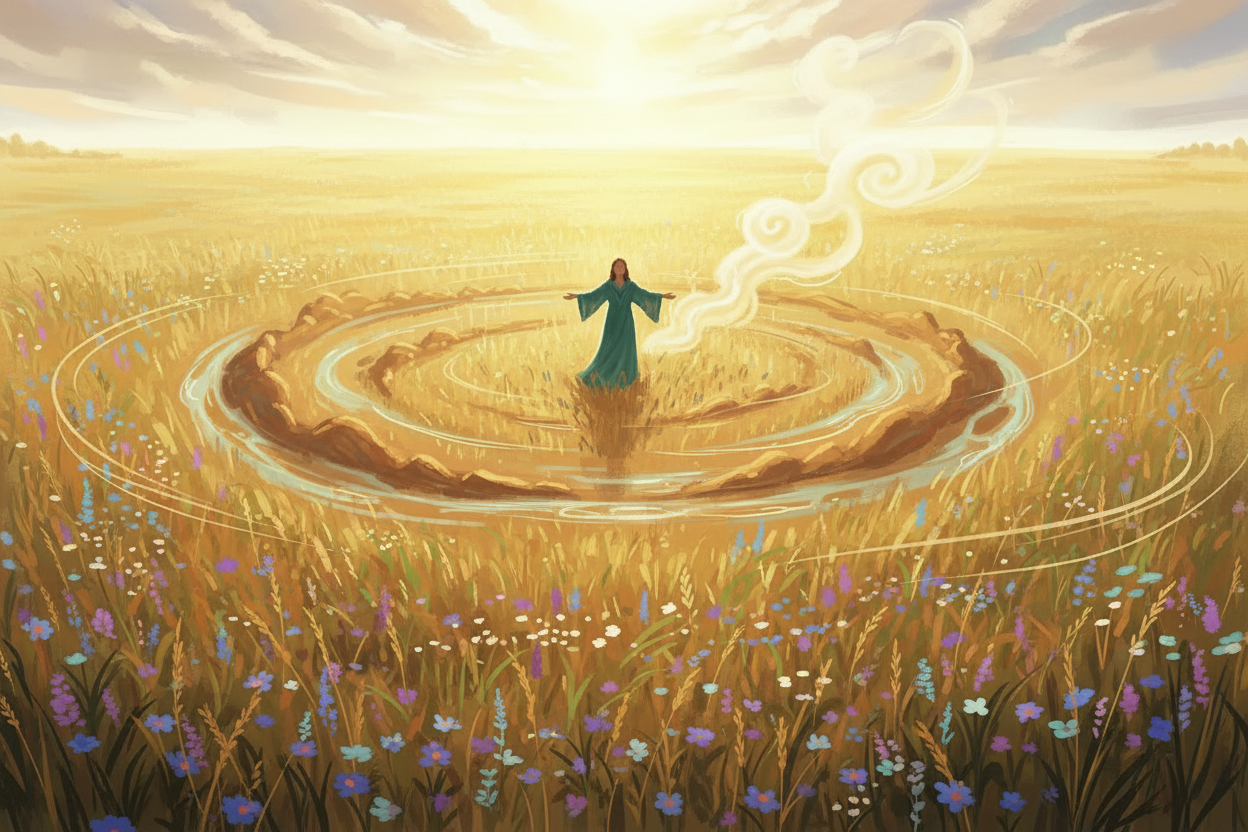
Ceremony, at its core, is no spectacle polished for the eye of strangers. It is not theater staged to dazzle or impress. Rather, it is a human and more-than-human act of remembering—a deliberate turning toward interrelationship. When we step into ceremonial space, we do not merely observe an event; we enter into intimacy with people, place, and the spirits that dwell within and beyond the visible. People, earth, air, fire, water, memory, weather, music, silence, and the ancestral and elemental presences begin to weave themselves into one another, until the ordinary is transfigured by the simple offering of mutual attention. In that weaving, isolation dissolves and kinship expands.
What grants such gatherings their quiet power is not symbolism alone, but the careful design of presence that honors reciprocity. A true ceremonial circle does what modern life so rarely permits: it allows the body to know what the mind cannot fully articulate. Standing upon the earth, we feel its patient density rise through the soles of our feet while sensing the spirits of place that dwell in soil and stone. Breathing the air, we sense the invisible currents that have traveled across continents to fill our lungs, carrying also the breath of those who came before. Watching flame dance, we remember transformation’s fierce mercy and the illuminating spirits of fire. Touching water—whether in a bowl, a river, or the tears that rise unbidden—we learn again the language of flow, release, and the compassionate spirits that move through every current. In these encounters, we recognize ourselves as threads within a vast, breathing web of interrelationship.
We hunger for this shared meaning with a depth that modern substitutes can never quite satisfy. When communities abandon their seasonal rites, their thresholds of passage, their collective moments of reverence, the longing does not vanish; it merely seeks other forms. Crowds surge, entertainment dazzles, political fervor sweeps us into chants that feel momentarily sacred. Yet these gatherings, for all their heat, often lack the tenderness that true ceremony offers—the deliberate recognition of interrelationship with people, elements, and spirits. Ceremony invites us to stand barefoot on soil beside one another, to feel wind against skin while acknowledging the unseen, to honor the fire that cooks our shared meal, to pour water in gratitude for both the living and the ancestral. These acts root us in mutual belonging rather than mere excitement.
There is profound intelligence in the cycles that shape all existence, and ceremony teaches us to enter them in relationship rather than isolation. Day yields to night, action softens into rest, winter draws life inward while spring coaxes it outward once more. Fire teaches the necessity of burning away what no longer serves; water reminds us that rigidity breaks while flexibility endures; earth models the patience of slow growth; air whispers that nothing can be held forever. The spirits of these elements and of our human and more-than-human kin walk with us through these teachings. To live well is to listen rather than resist. Ceremony becomes the vessel through which we remember: it marks the planting and the harvest, the first breath of a child and the last of an elder, the grief that carves us open and the gratitude that fills the hollow places—always in the company of people, elements, and spirits.
To create a meaningful ceremony is to transform a fleeting moment into an occasion of deliberate care for interrelationship. It requires clarity of intention, a reverence for relationship that extends to every person present, to the earth beneath, the air around, the fire among us, the water we share, and the spirits that witness and participate. When we gather with such purpose, we are not filling empty hours; we are shaping memory, devotion, and community across the visible and invisible. We are declaring that life deserves to be marked, that connection with one another, with the elements, and with the spirits deserves to be honored, and that even in a fragmented age we can still craft spaces where the heart recalls what it means to belong together.
Consider how the elements themselves become teachers and partners within the ceremonial circle, while people and spirits complete the living web. Earth, solid and unhurried, invites us to ground our restless minds and to offer our weight without apology, held also by the spirits of place. Air, ever-moving, carries our prayers, our silences, and the voices of those beside us, reminding us that every breath is a shared and borrowed gift. Fire, both destroyer and illuminator, burns away pretense and reveals the gold of authentic presence among us. Water, shape-shifting and compassionate, washes away the residue of isolation and teaches the grace of yielding to one another and to the more-than-human. Together they form a living altar of interrelationship, deepened by the simple act of acknowledging people, elements, and spirits as kin.
In the presence of these companions—human, elemental, and spiritual—ceremony becomes a dialogue rather than a monologue. We speak, and the wind answers by shifting the leaves while the spirits of air listen. We pour water, and the earth drinks it with quiet acceptance as the spirits of the land receive our offering. We light a flame, and shadows dance in conversation with the dark and with the illuminating presence of fire’s spirit. We sit upon the ground beside one another, and the soil holds the stories of those who sat before us, human and ancestral. This reciprocity is the essence of belonging: not a one-sided claim upon the world, but a mutual recognition that we are of it, sustained by it, responsible to it, and held in relationship with people, elements, and spirits alike.
Such practices restore a rhythm that industrial time has nearly erased. They teach us that arrival is not a destination but a continuous practice—arriving into the body, into the breath, into relationship with the people around us, the elements that compose us, and the spirits that move through and beyond us. Without this arrival into interrelationship, we remain perpetual travelers through our own lives, never fully inhabiting the places, the moments, or the kinship that call to us. Ceremony slows the pulse of existence just enough for recognition to occur: the recognition that we are not separate from the weather that shapes our moods, the soil that feeds our bones, the fire that warms our gatherings, the water that courses through our veins, the people who share the circle, or the spirits who walk with us.
And so we return, again and again, to the quiet threshold. In a world that prizes speed and spectacle, we choose instead the hidden architecture of pause, of shared breath, of elemental and spiritual kinship. We gather not to perform belonging but to remember it—to feel earth, air, fire, and water as intimate relations, to stand shoulder to shoulder with one another, and to welcome the spirits that have always been present. In that remembering of interrelationship, isolation softens, hunger finds true nourishment, and the heart, at last, knows the deep poetry of home among people, elements, and spirits.